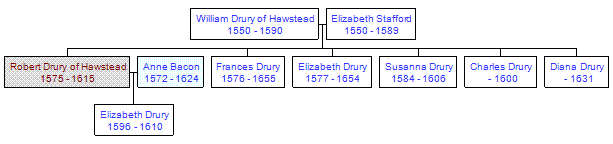
Sir Robert Drury of Hawstead
Robert Drury of Hawstead
30th Jan 1575 - 1615
Life History
30th Jan 1575 |
Born in Halstead, Suffolk |
30th Jan 1592 |
Married Anne Bacon |
1596 |
Birth of daughter Elizabeth Drury |
Dec 1610 |
Death of daughter Elizabeth Drury |
1615 |
Died |
Notes
From 'The History of the Family of Drury In the Counties of Suffolk and Norfolk From the Conquest' by Arthur Campling, London, 1937.
"was born 30 January 1574-5 at Durham House within the precincts of Westminster and was therefore fifteen at the time of his father's death. In 1591 Elizabeth sent Essex with a small army to help Henry IV against Philip and the League. Robert Drury went in Essex's train and at the Siege of Rouen 8 October 1592 was knighted by Essex, being then in his sixteenth year."
In March 1599-1600 it is on record in the State Papers that:
"On Saturday Sir William Woodhouse with four hucksters laid wait for Sir Robert Drury coming from Tottenham to London wounded him in three or four places and left him for dead but he is likely to recover; his man defending him was slain - the match was very uneven five to two"
In June 1600 it was reported "that Lord Gray received a hurt in the face (in the Low Countries) and had lost his life if Sir Robert Drewye had not rescued him'.
John Chamberlain wrote under date 1 July 1600 news of the great fight near Nieuport. Sir Francis Vere received three wounds and his horse was killed under him, but being mounted behind Sir Robert Drury he came off again - about 500 English were lost - Charles Drury brother to Sir Robert and 16 gentlemen of Sir Francis' company - no commander of note that was not taken or slain - it has been the greatest battle of our times between two disciplined armies."
"Drury, probably owing to his having been so much with Essex, was out of favour, and wrote to Sir Robert Cecil on New Years day 1600 protesting that never in his life there passed through his lips which might tend to a want of faith or respect to the sacred throne or person of the Queen."
"The town house of the Drurys of Hawstead in the time of Elizabeth was Drury House in Drury Lane, built by Sir William Drury of Hawstead, and on the death of his son Sir Robert Drury passing into the possession of the Earls of Craven, and then called Craven House. It was in the parish of St. Clement Danes
It was a five storey house, with eleven small windows on each storey, intersected by Doric and Ionic pilasters. The entrance was through a pair of gates which led into a large coach yard, and at the back was a handsome garden. The house was taken down in 1809.
The Cockpit or Phoenix Theatre in Drury Lane was in the parish of St. Giles-in-the-Fields, and was pulled down 20 Mch. 1649.
The Olympic Theatre, Wych Street, Drury Lane, was built in 1805 by Philip Astley of Astley's amphitheatre on the garden ground of old Craven House; and was burnt to the ground March 29, 1849 and rebuilt."
"Thomas Foderingey, by his will 1490, gave to Margaret his wife his Manor of Brockley Hall for life, and she remarried John Drury, who in her right held a court for the manor in 1492. On her death the manor passed in moieties to Margaret and Helen her .daughters, Christian having died without issue. The respective husbands of Margaret and Helen held their first court in 1499. Margaret died 20th Feb. 1514, and her husband a few days after her, leaving Edmund Beaupré, their son and heir."
"Edmund Beaupré had livery of half the manor in 1521. The other moiety was in trustees, George Waldegrave, Philip Boteler, John Jernegan, who with Edmund Beaupre held a first court nth April, 1517. George Waldegrave and others in 1520 levied a fine of a moiety of the manor against Thomas Pakeman and others, and this moiety was purchased by Robert Drury, of Hawstead, who died seised of the same 2nd March, 1534, when it passed to his son and heir. Sir William Drury, who the following year acquired the remaining moiety of Nicholas Beaupre and others, and on the death of the said Sir William in 1589 the entirety of the manor went to his widow Elizabeth, who remarried Sir John Scott, who became lord in her right, and held a court for the manor 15th April, 1591."
"On his mother's death Sir Robert Drury, Knt., succeeded, and dying 2nd April, 1615, the manor passed to his three sisters and coheirs - Frances, married 1st to Sir Nicholas Clifford, and 2ndly to Sir William Wray, of Glentworth, CO. Lincoln, Bart.; Elizabeth, wife of William Cecil, son and heir of William, Earl of Exeter; and Diana, wife of Sir Edward Cecil, Viscount Wimbledon. The 1st May, 1617, a court of the manor was held by Sir Edward Cecil and Diana his wife, and Sir William Wray in right of his wife Frances."
From 'A Who's Who of Tudor Women'
"Drury House was a meeting place for conspirators in the Essex rebellion of 1601, but Drury himself was cleared of charges of treason."
From 'The History of Parliament'
"Biography [Author: John. P. Ferris]
... by the sixteenth century the Rougham branch had been overshadowed by their kinsmen at nearby Hawstead. Consequently, although this Member needs to be distinguished from the head of the elder line, a namesake knighted at James I's Coronation, there can be little doubt as to his identity. ..
...Sir William, this Member's father .. married one of Elizabeth's ladies of the Bedchamber and became receiver of Crown lands for Essex, Hertfordshire, London and Middlesex. Mortally wounded in a duel with a brother officer in the Low Countries in January 1590, he left debts of over £6,000, of which more than half was due to the Crown. As Drury was then still a minor, his mother was obliged to purchase his wardship for £166 13s. 4d. However, in 1591 the Drury estate was confiscated by the Crown for Sir William's debts, and the wardship was regranted to lord keeper Puckering (John Puckering). Sir William's former sureties, led by Nicholas Bacon, thereupon agreed to pay off the debt in return for a lease of the estate, while Drury's mother and stepfather, Sir John Scott*, bought out Puckering.
Drury was knighted at the siege of Rouen in 1591 by Robert Devereux, 2nd earl of Essex .. and married Bacon's daughter four months later on his seventeenth birthday. .. Two years later Bacon purchased Drury's wardship. In 1596, 'desirous to follow the wars', Drury was given command of a company in the Ostend garrison, but there is no evidence that he took up the appointment.
In September 1598 Drury was reportedly intent on accompanying the English general Sir Francis Vere to the Low Countries, but he was evidently still in England the following 1 Mar., when he was attacked by Sir William Woodhouse, with whom he had served in Normandy and his rival for a commission in the Netherlands. Chamberlain reported that although Drury had been 'left ... for dead', he was 'like to recover', and indeed later that year he served under Essex in Ireland.
During the winter of 1599-1600, Drury visited Paris on an unofficial mission to the duke of Bouillon, submitting a report to Sir Robert Cecil on 15 January.
The following summer he distinguished himself as a volunteer in the Netherlands, rescuing Vere at the battle of Nieuwpoort.
Back in England the following December, he was arrested for having criticized Elizabeth over her treatment of Essex. However, the accusation, which came from a disgruntled servant, was not corroborated, and the ensuing investigation meant that he was unable to participate - had he wanted - to in the Essex rising of February 1601. He was subsequently allowed to return to the Netherlands, where he took command of an infantry company.
Drury remained in Dutch service until his men went into winter quarters in 1602.
.. He subsequently journeyed to Italy. .. Back in England by early 1604, he was returned for Suffolk, probably thanks to his father-in-law's influence. ..
By 1605 Drury was a gentleman of the privy chamber. The remainder of his father's debt to the Crown, amounting to almost £626, was remitted before he accompanied the 1st earl of Nottingham (Charles Howard) on his mission to Spain, where it was rumoured, falsely, that he had killed Sir Robert Killigrew in a duel. ..
Drury may not have returned to England by the time Parliament reconvened in November 1605. After the Christmas recess, and in the wake of the Gunpowder Plot, Cecil, by now earl of Salisbury, determined to clamp down on English recruitment for the Spanish forces, and on 6 Feb. 1606 the Commons resolved to find a remedy for 'the danger of such as do or shall serve in the Spanish wars'. It was perhaps unwise of Drury, whose cousin, Ambrose Rookwood, had been executed for his complicity in the Plot, to intervene in the ensuing debate, in which he related the assurances he had been given that Protestants were welcome in the Spanish forces. ..
Salisbury, whose nephew William Cecil, Lord Burghley, had married one of Drury's sisters, sent for Drury to explain his speech. Drury argued that the proposal to prevent Englishmen from serving in the armies of Spain threatened 'that liberty we have now in going beyond the sea'. ..on 13 Feb., presumably attempting to repair his anti-Catholic credentials, Drury offered an additional clause to the bill against recusancy. ..
..
Drury was named to five further committees during the course of the session, among them the committee for the bill to pave Drury Lane (19 Mar.), which had acquired its name from the town house built by his father near its junction with the Strand. However, he can have taken no part in the discussion of the measure, for he was attacked by a burning ague and confined to his chamber for a fortnight. ..
..
On 18 May Drury was granted of two-thirds of the Rookwood estate, forfeited for recusancy.42 He managed his own interests so prudently that by 1609 he had cleared his father's debts. With an income approaching £3,000 he was able to look round for investments. He enlarged his property by the purchase of Hardwick for £1,100, rebuilding the manor house and founding almshouses, and he later adventured £200 in the first joint stock of the East India Company. A more modest subscription of £10 earned him a seat on the Virginia council.
Henry Howard, Earl of Northampton, wrote to Sir Charles Cornwallis in July 1609 that Drury was doing everything he could to succeed Cornwallis as ambassador to Spain .. but in this ambition Drury proved unsuccessful.
..
In August 1610 Drury took his wife and daughter to Spa. He appears to have returned to England by December, when the daughter, his only surviving child, was buried at St. Clement Danes. ..
John Donne wrote two of his most elaborate poems on the death of Drury's daughter, and the two men travelled together on the Continent in the winter of 1611-12, taking in Amiens, Spa and Heidelberg, where Drury formed a poor opinion of the Elector Palatine. On his return to England, Drury was reproved by the Privy Council for scandalous speeches about the king's intended son-in-law. In the following year Sir Henry Wotton reported:
Sir Robert Drury runneth at the ring, curveteth his horse before the king's window, haunteth my Lord Rochester's chamber, even when himself is not there, and in secret divideth his observances between him and the house of Suffolk; and all this (they say) to be ambassador at Brussels.
Later Chamberlain reported that he was willing to pay £2,000 for the Venice embassy.
.. 1614 Drury was .. returned at Eye, where his father-in-law, Sir Nicholas Bacon, was influential.
..
Surviving less than a year after the dissolution of his last Parliament, Drury died of a fever on 2 Apr. 1615, and was buried at Hawstead the following June. .. The estate was to be divided among his three surviving sisters, the youngest subsequently marrying Sir Edward Cecil. Hawstead went to Sir William Wray, whose grandson sold it in 1656.